
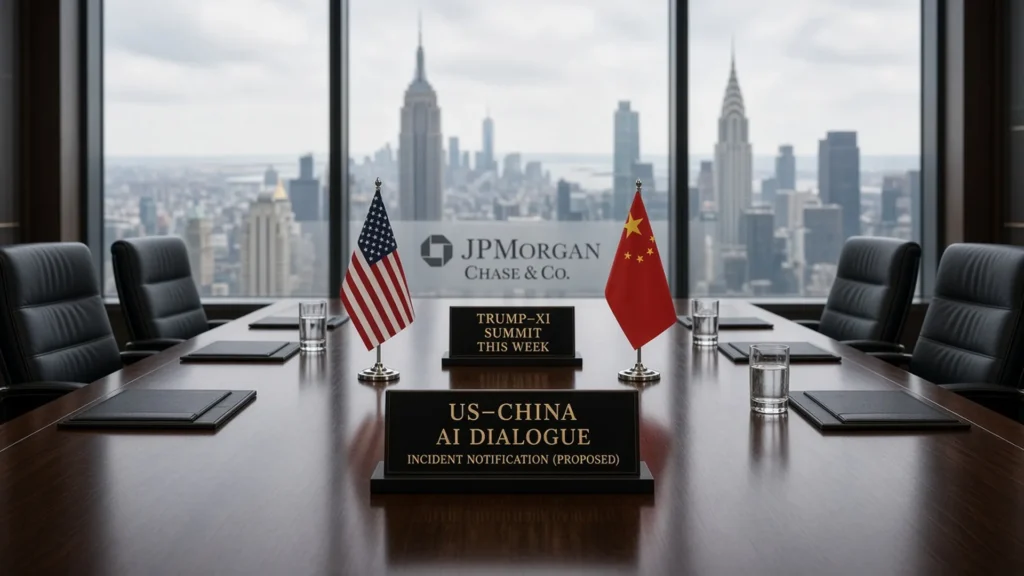
After New York talks with Chinese Vice Premier He Lifeng, Treasury Secretary Scott Bessent said the U.S. proposed a U.S.–China AI dialogue and a national-security notification mechanism for AI incidents ahead of this week’s Trump–Xi summit.
U.S. Treasury Secretary Scott Bessent and Chinese Vice Premier He Lifeng concluded talks in New York on Sunday with Washington proposing a new AI safety notification mechanism for President Donald Trump and Chinese President Xi Jinping to consider at their summit this week, Reuters reported.
Bessent told reporters the sides discussed setting up a new U.S.–China AI dialogue, with emphasis on national-security concerns and a notification system for common goals and threats covering AI-related incidents that rise to a national-security level. “We think that, just like with any cross-border activity, that moving from opaque to more transparency between the number one and the number two AI powers in the world is very important,” he said after the meeting.
Trump and Xi first discussed potential consultations on AI development in May in Beijing, but that forum was never formalized. China’s response to the new U.S. proposal was unclear: a Xinhua readout only briefly acknowledged that both sides spoke about AI, while describing “frank, in-depth and constructive exchanges” on key economic and trade issues. He and China’s chief trade negotiator Li Chenggang left JPMorgan Chase headquarters in New York without speaking to media.
U.S. Trade Representative Jamieson Greer said export controls on sophisticated AI chips and semiconductor manufacturing equipment were not on the agenda for the AI-mechanism talks. Greer said Sunday’s discussions were meant to prepare groundwork for a “successful summit” between Trump and Xi next Thursday and Friday in Washington. The meeting also covered plans to “operationalize” a May process for identifying possible tariff cuts on non-strategic goods; Greer and Bessent did not claim progress on critical-minerals flows.
This brief covers the attributed U.S. proposal from the weekend government talks. It is not a signed treaty or an operational hotline. It is distinct from AI Tech Daily’s earlier coverage of Track II expert proposals for nuclear-style AI red lines and a hotline and from September reporting that officials were gearing up for dialogue.