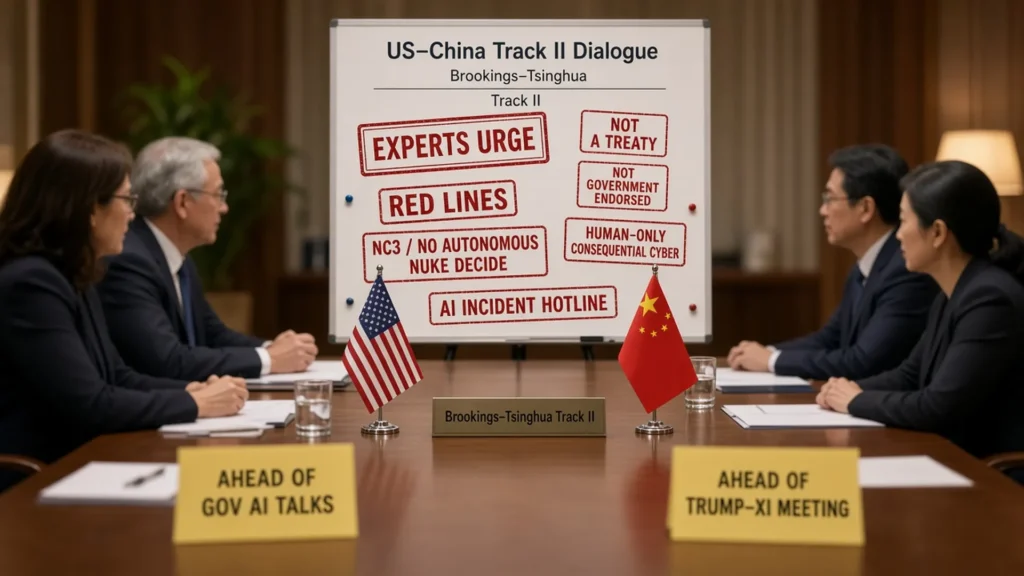
U.S. and Chinese security experts are urging Washington and Beijing to prepare nuclear-style safeguards for military AI risks, including red lines around nuclear systems, human control over consequential cyberattacks, and a hotline for autonomous AI incidents, Reuters reported from Beijing.
The recommendations were published last week ahead of planned government-level AI talks and an expected September 24 meeting in Washington between President Donald Trump and Chinese President Xi Jinping. Authors Melanie Sisson, a Brookings Institution senior fellow, and Tianjiao Jiang, an associate professor at Fudan University, take part in a U.S.–China AI and national security dialogue convened since 2019 by Brookings and Tsinghua University’s Center for International Security and Strategy. Neither government has publicly endorsed the proposals, Reuters said.
Sisson argued humans should retain sole authority to initiate AI-enabled cyberattacks against the other country’s nuclear command, control, and communications systems or strategically important infrastructure. Jiang proposed explicit red lines preventing AI from independently deciding to use nuclear weapons or autonomously attacking nuclear command systems, plus protections for critical infrastructure such as energy, finance, and healthcare, and a shared definition of “meaningful human control.”
Jiang also proposed a dedicated U.S.–China military hotline for AI incidents, warning that automated cyber exchanges could escalate too quickly for human intervention. A hotline could let one government say an unusual AI operation was accidental, unauthorized, or still under investigation before it was treated as deliberate state action. Reuters noted skeptics of existing crisis lines, including questions about response speed after past incidents such as the 2023 spy balloon episode.
The package shows how U.S.–China AI rivalry is expanding from chips and models into strategic-stability questions long associated with arms control: preventing accidents from being mistaken for attacks and keeping the most consequential military decisions with humans.
This brief covers the attributed expert proposals as reported by Reuters. It does not treat them as official U.S. or Chinese policy, and it is separate from coverage of the King Charles AI safety summit already live on AI Tech Daily.