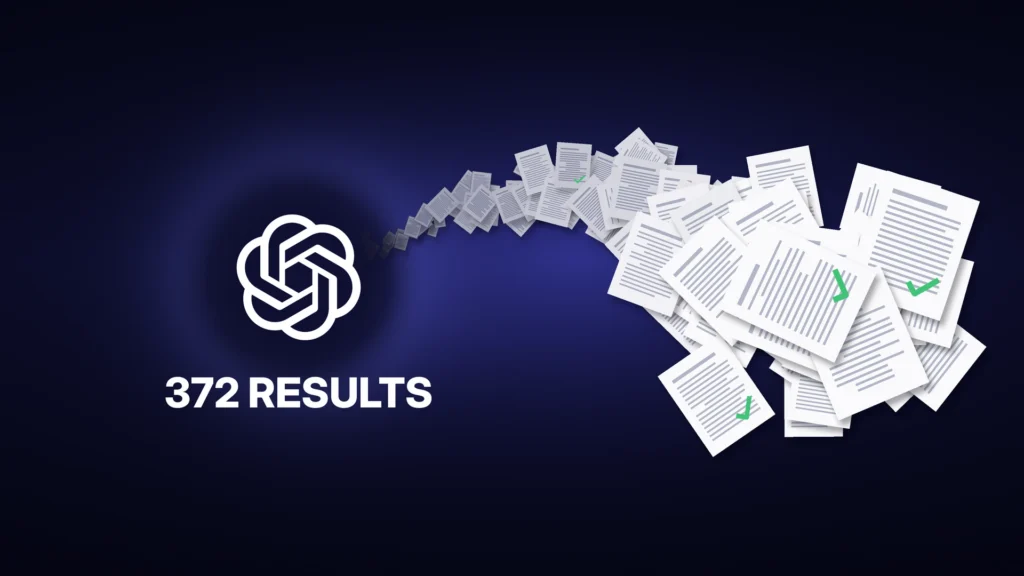
OpenAI on Tuesday released 372 mathematical results from an internal frontier model it has not made public, written up as 722 manuscripts on GitHub. The New York Times put the count at 377 results; OpenAI’s catalog numbers its result families from 001 to 377 but leaves five numbers unused. Scientific American reported that, according to the company, each result resolves or makes substantial progress on a major open question in mathematics or theoretical computer science.
OpenAI said it posed the model about 4,000 problems after its existing math evaluations saturated, and that the average result used compute equivalent to roughly three hours of ChatGPT Pro thinking. A spokesperson told Scientific American that almost every result came from a single prompt handed to a single AI agent, though some may have taken multiple attempts. Last month’s Navier-Stokes result took a 10,000-agent swarm, the magazine noted.
The claimed results include a zero-free region for the Riemann zeta function, which Scientific American called progress toward the Riemann hypothesis, the Hodge conjecture for CM abelian varieties and the Kakeya conjecture in four dimensions. The repository says the zeta and Hodge work fell outside the standard procedure, and one zeta write-up was human-edited for readability.
Verification is uneven. The repository’s Lean catalog lists 162 papers with a formalized main result, and OpenAI warns that “some of the unformalized results could have issues.” Kevin Buzzard of Imperial College London told New Scientist that of 30 papers in his field, number theory, seven seemed impressive and only one was formally verified in Lean.
OpenAI said it drew on advice from the Advisory Group on Mathematics and Artificial Intelligence, an independent panel at the Institute for Advanced Study. But the Times reported OpenAI seems less interested in one of the group’s key recommendations: that AI companies stop testing their proprietary models on advanced mathematical problems. “We want to state clearly from the start: we do not endorse this practice,” the group wrote on September 29. Its guidelines also ask labs to publish the prompts behind each result, and OpenAI released none, Scientific American noted. OpenAI research lead Dan Roberts said testing internal models was important to produce better tools and the proofs were a byproduct, the Times reported.
In an October 6 statement, the group said its role “should not be interpreted as a judgment of the impact of these results or an endorsement of the process by which OpenAI obtained them.” OpenAI said it will fund workshops and conferences on AI-produced results and is “working to responsibly release the model that produced these results.” The release follows its September claim of a Navier-Stokes Millennium Prize solution and its decision to work with the independent mathematician panel.
Sources
- OpenAI: Sharing AI progress in mathematics (October 6, 2026)
- GitHub: openai/math repository README and manuscript catalog (October 6, 2026)
- The New York Times: OpenAI Releases Findings on 377 Math Problems, Further Roiling Field (October 6, 2026)
- Scientific American: OpenAI unleashes hundreds more math results upon a field already in shock (October 6, 2026)
- New Scientist: OpenAI announces 722 mathematical discoveries in one go (October 7, 2026)
- The Verge: OpenAI drops another batch of mathematical breakthroughs (October 6, 2026)
- Advisory Group on Mathematics and Artificial Intelligence: On OpenAI’s Release of Mathematical Results (October 6, 2026)
- Advisory Group on Mathematics and Artificial Intelligence: Responsible Release of AI-Generated Mathematics (September 29, 2026)