
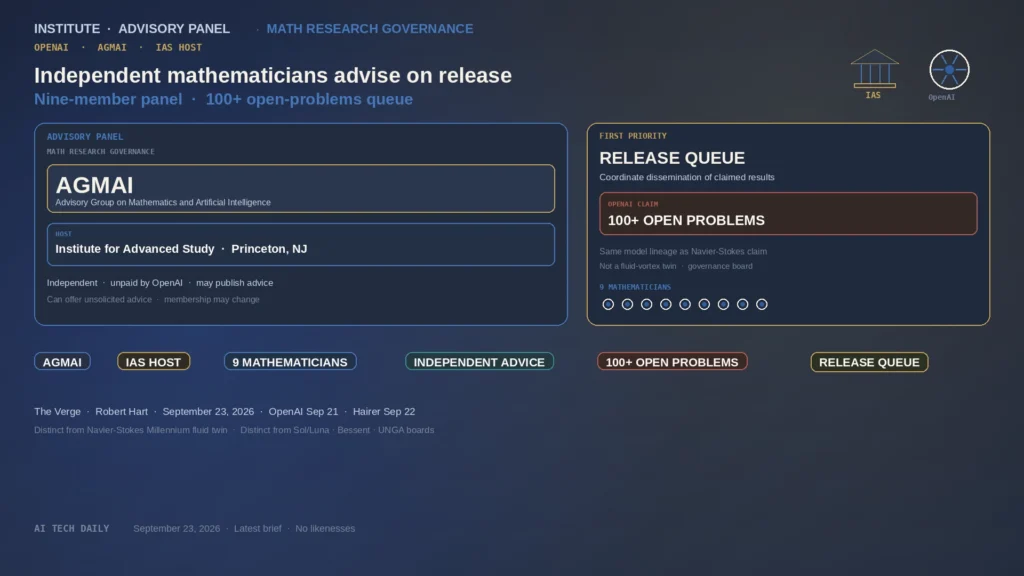
OpenAI said on September 21, 2026 that it is working with an independent Advisory Group on Mathematics and Artificial Intelligence (AGMAI) — a nine-member panel hosted at Princeton, New Jersey’s Institute for Advanced Study — to advise the company and other AI labs on interactions with mathematical research, including how new results are reviewed, presented, and released, The Verge reported on September 23, 2026.
Members are drawn from institutions including Stanford, Harvard, Oxford, Cambridge, and IAS, with multiple Fields Medals and MacArthur grants among them. OpenAI’s announcement says the group can offer unsolicited advice, publicly comment on the company’s impact on mathematics, and make its advice public; members are not paid by OpenAI and may change the group’s membership. The company said the panel will help assess significance, coordinate dissemination, and advise on academic standards — while noting it will not advise OpenAI on how fast to pace internal math progress.
The group’s materials say it came together after OpenAI approached some members about an external advisory board; following discussions, the mathematicians launched an independent group instead and invited others to join. In a September 22, 2026 Proofs and Prompts blog post, AGMAI member Martin Hairer wrote that the panel is “genuinely independent,” receives no pay, relies on IAS for technical support, and has no restrictive speech agreements beyond confidentiality.
Hairer said the first priority is advising on how to coordinate release of a large number of significant mathematical results OpenAI says an unreleased internal model produced. OpenAI claims that model — the same lineage as its Navier-Stokes Millennium Prize claim — has “resolved more than 100 long-standing open problems across most areas of mathematics.”
Mathematicians who spoke to The Verge called the panel a useful first step while questioning influence, selection, and representativeness; some described an “ivory tower” feel. Imperial College London’s Kevin Buzzard asked why an elite body was needed to hear what the community had already said after prior OpenAI math controversies over scooping, credit, and communication of results.
Sources
- https://www.theverge.com/ai-artificial-intelligence/999167/openai-elite-mathematicians-panel
- https://openai.com/index/advisory-group-on-mathematics-and-ai/
- https://proofsandprompts.com/2026/09/22/why-i-agreed-to-join-agmai/
- https://terrytao.wordpress.com/2026/09/21/advisory-group-on-mathematics-and-artificial-intelligence/
- https://www.aitechdaily.com/openai-navier-stokes-millennium/