
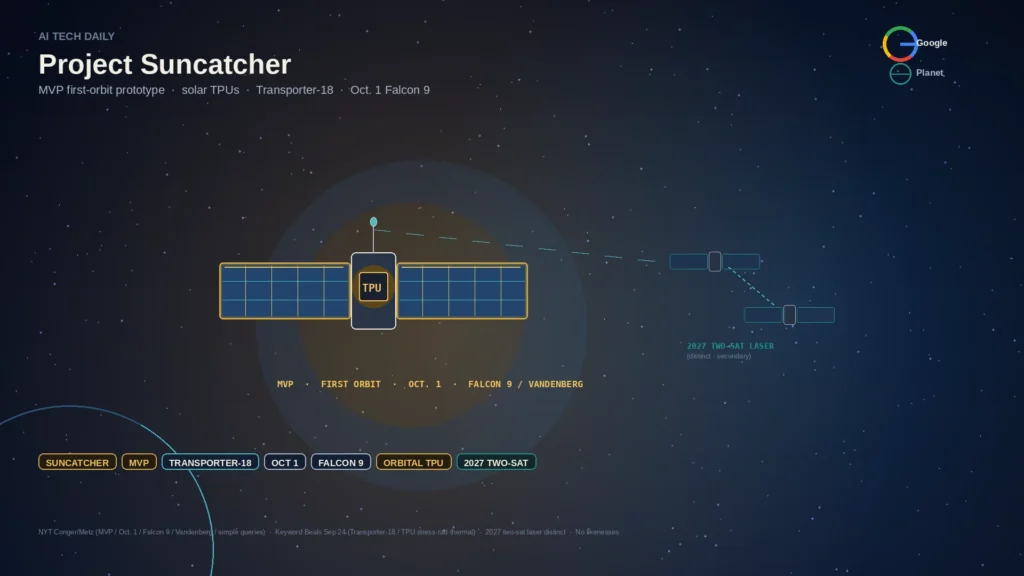
Google plans to send an experimental satellite into orbit next week with enough computing power to answer simple A.I. queries from space, The New York Times reported on Thursday, September 24, 2026.
According to Kate Conger and Cade Metz, writing from San Francisco, the satellite Google named MVP is scheduled to launch on Oct. 1 aboard a SpaceX Falcon 9 from Vandenberg Space Force Base. The Times described the craft as refrigerator-size and said it had passed vibration testing with its chips intact. The free preview framed the flight as a first step toward answering simple queries from orbit; the full article is paywalled.
A same-day Google Keyword post by Travis Beals, senior director for Paradigms of Intelligence, describes the mission as Project Suncatcher’s first test in orbit: a prototype satellite evaluating how Google Tensor Processing Units perform in space. Beals said the initial flight is onboard the upcoming Transporter-18 rideshare with SpaceX, developed in partnership with Planet, and is designed to gather in-orbit data on how TPUs handle spaceflight stress plus radiation and thermal extremes. Keyword does not name the craft MVP, give an Oct. 1 calendar date, or say the satellite will answer queries; those details remain Times attributions. Beals wrote that putting Google’s first TPUs in orbit “next week” will supply data for future launches, and that vibration testing surprised the team when the hardware held up. The post also cites Trillium proton-beam radiation tests at UC Davis’s Crocker Nuclear Laboratory.
That Transporter-18 prototype is distinct from Google’s next Suncatcher milestone. Beals said the company will test laser interconnect work in 2027 when it puts two satellites in orbit. A Nov. 4, 2025 Keyword announcement, a companion Google Research blog, and a Planet Pulse note had already framed Project Suncatcher as a solar-powered TPU constellation moonshot and a Planet-built two-prototype learning mission targeting early 2027 for optical crosslinks. Those two birds are not the Oct. 1 / Transporter-18 first-orbit test described this week.
Sources
- https://www.nytimes.com/2026/09/24/technology/google-suncatcher-ai-data-center-space.html
- https://blog.google/innovation-and-ai/models-and-research/google-research/google-project-suncatcher-facts/
- https://blog.google/innovation-and-ai/technology/research/google-project-suncatcher/
- https://research.google/blog/exploring-a-space-based-scalable-ai-infrastructure-system-design/
- https://www.planet.com/pulse/planet-to-build-and-operate-advanced-space-platform-for-google-s-project-suncatcher-moonshot/