Google’s Private AI Compute team published an architecture update on Wednesday, September 23, 2026, describing how the platform will add persistent, encrypted server-side memory while keeping cryptographic keys exclusively on users’ personal devices — inaccessible even to Google, according to the DeepMind blog post. The work was co-developed by Google DeepMind, Platforms & Devices, Core, and Cloud.
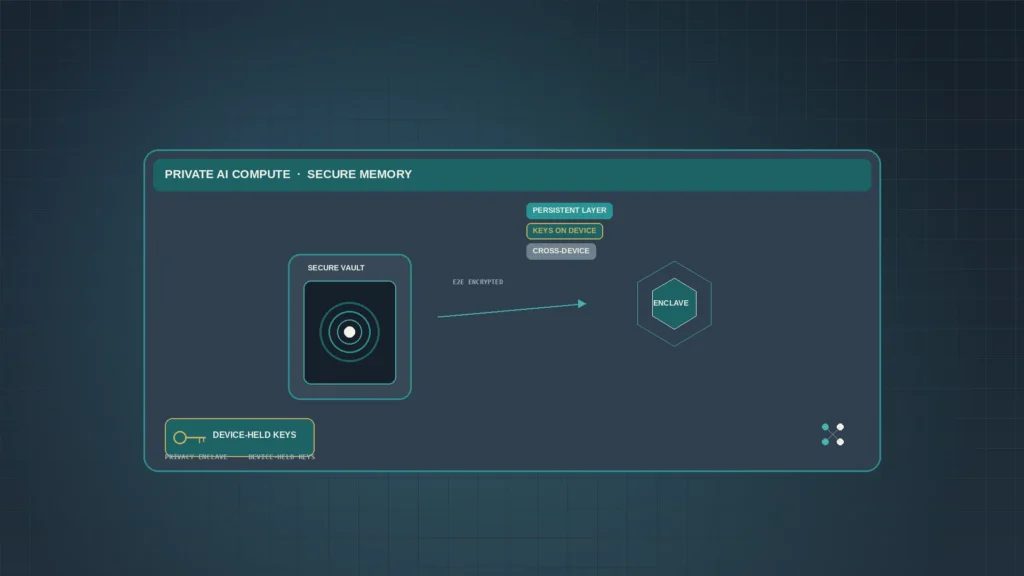
Until now, Private AI Compute processed complex tasks in hardware-isolated cloud enclaves but stayed strictly stateless: context was wiped when a task ended. The new design adds a persistent memory layer that functions like a secure digital vault in the cloud. Personal context is sealed in dedicated encrypted storage; the keys that unlock it remain on-device.
When a model needs that context, the device opens an authenticated, end-to-end encrypted channel to a protected secure enclave. Data is temporarily decrypted in isolated memory to handle the request, any new context is saved, and the material is immediately re-encrypted. The post frames the goal as cross-device continuity — for example, resuming work that began on smart glasses on a laptop — without treating cloud retention as a privacy trade-off.
Alongside the update, Google said it is publishing a refreshed technical whitepaper/brief, a tamper-proof public record of server software so devices can attest authenticity before sending personal data, and results from an independent cybersecurity audit. The post invites the privacy community to review the architecture, security proofs, and verification protocols.
This brief covers the company architecture update — persistent encrypted memory, device-held keys, enclave decrypt/re-encrypt, and the transparency artifacts. It does not invent a consumer general-availability date, claim the memory layer is already live for end users, or restate separate AI Tech Daily coverage.