
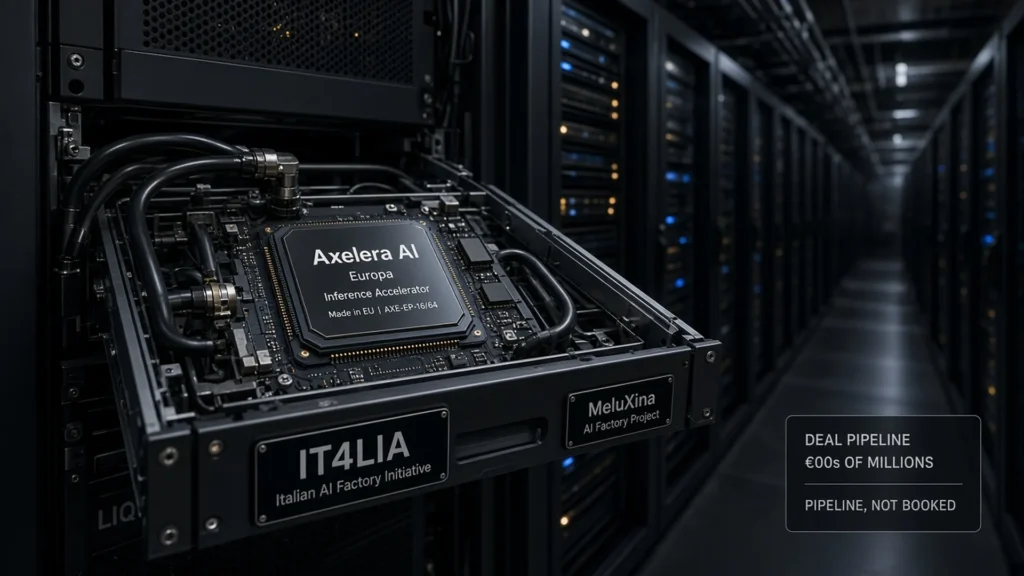
The Dutch inference-chip startup told Reuters it signed supply contracts worth tens of millions, is pursuing a $1.5 billion pipeline, and launched second-generation Europa chips usable in specified Dell and Supermicro gear.
Dutch chipmaking startup Axelera AI has signed multiple contracts to supply chips to AI factories and launched Europa, its second generation of inference chips usable in specified Dell and Supermicro products, Reuters reported from Amsterdam on September 15.
The European Union is converting supercomputing centers into AI factories to narrow gaps with the U.S. and China and give local firms and scientists access to AI compute. Axelera said it is working with Dell and systems integrator E4 as one of the suppliers for the EU-backed IT4LIA project in Italy and the EU-backed MeluXina project in Luxembourg, among others.
Axelera focuses on AI inference (running models, not training them). Its first-generation Metis chips targeted edge applications such as on-site security analytics. Europa is designed for heavier jobs on corporate servers, while a future Titania chiplet architecture is aimed at data centers and supercomputers. European peers include France’s VSORA, Britain’s Fractile, Spain’s Semidynamics, and the Netherlands’ Euclyd, which separately announced a €200 million funding round on Tuesday, Reuters noted.
This brief covers Axelera’s announced deals and Europa launch as reported. It does not treat the $1.5 billion pipeline as booked revenue.
Sources
An AI factory is a data center or scientific computing center devoted to training and running AI software. CEO Fabrizio Del Maffeo told Reuters the company now has more than 600 customers using Axelera chips in security, defence, AI factories, and enterprise settings. “We have signed deals worth tens of millions,” he said. He added that Axelera is pursuing $1.5 billion in potential sales, a pipeline figure that does not represent orders or revenue. Privately held Axelera has raised more than $450 million since its 2021 founding in Eindhoven.