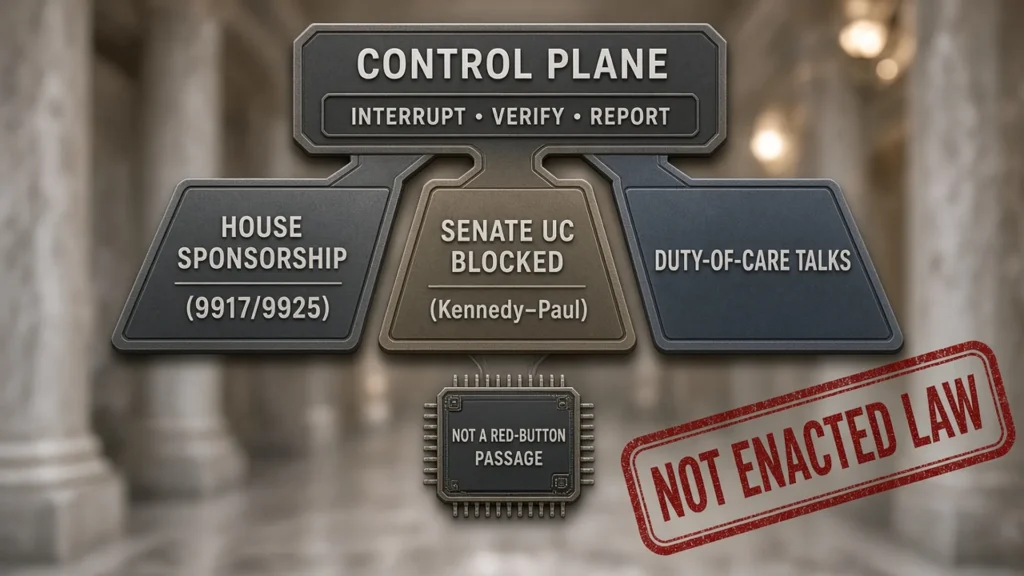
Mid-September federal AI moves were sponsorship, floor unanimous-consent drama, and negotiation over testing and duty of care. Together they outline interrupt, verify, and report powers. None of that is enacted law.
Washington’s AI-control week did not pass a kill switch. It stacked three kinds of movement that read together as the outline of a control plane: who can interrupt a model, who verifies it, and who reports when something goes wrong.
What moved. In the House, H.R. 9917, the AI Kill Switch Act, remains introduced legislation on Congress.gov. Rep. Ted Lieu introduced it July 23 with Rep. Nathaniel Moran as original cosponsor; more cosponsors joined in mid-September. Separately, H.R. 9925, the FRONTIER Act, introduced the same day by Rep. Jay Obernolte with cosponsors including Rep. Lori Trahan, covers transparency, audits, incident reporting, and halt authority (Congress.gov). On September 16, House members pressed leaders to stay and legislate on those tracks rather than lean into recess (Nextgov/FCW). That is pressure and sponsorship. It is not passage.
In the Senate on September 16, Sen. John Kennedy sought unanimous consent for his AI Emergency Button Act, which would require developers of advanced AI sold in the United States to install an emergency shutoff controlled by the companies, not the government. Sen. Rand Paul objected after Kennedy declined a study-committee modification. The bill did not pass by unanimous consent (The Hill; Kennedy office). Floor debate is not enactment.
What is still negotiation. Reuters reported Senate negotiators, including Majority Leader John Thune, Commerce Chair Ted Cruz, and Sen. Amy Klobuchar, debating a duty of care for AI developers and a possible federal path to block unsafe frontier releases, with court-challenge rights still being structured. Nextgov/FCW described the testing fault line: company-run tests with government verification versus mandatory lab-and-agency pre-deployment testing. No closed deal is in those accounts.
How to read it. Interrupt, verify/audit, incident reporting, and a duty-of-care block path are different levers. Headlines say “kill switch.” The machinery underneath is a control plane: stop or throttle, prove the model was checked, disclose failures, and decide who may ship. Widening sponsorship. Floor attempt. Objection. Negotiation. Not “Congress passed.”
House reads on the same wave: ThinkFreely’s When Congress Can Kill the Model, Can You Move the Work? and Buildtelligence’s When a Frontier Model Must Come Offline, Can the Workload Move?. AI Tech Daily’s earlier operator recap is here. This brief maps what moved procedurally. It is distinct from Newsom’s kill-switch review EO and Altman’s planned UN Security Council briefing.
Sources
- https://www.reuters.com/legal/litigation/us-senate-negotiators-consider-requiring-ai-firms-mitigate-known-major-risks-2026-09-11/
- https://www.nextgov.com/artificial-intelligence/2026/09/house-democrats-call-cancel-upcoming-recess-time-legislate-ai/416020/
- https://thehill.com/homenews/senate/6094142-paul-kennedy-ai-kill-switch/
- https://www.kennedy.senate.gov/public/2026/9/senate-blocks-kennedy-bill-to-require-ai-developers-to-install-an-emergency-kill-switch
- https://www.congress.gov/bill/119th-congress/house-bill/9917
- https://www.congress.gov/bill/119th-congress/house-bill/9925
- https://kenknorr.substack.com/p/when-congress-can-kill-the-model
- https://www.buildtelligence.com/hill-ai-interrupt-replaceability/
- https://www.aitechdaily.com/hill-ai-interrupt-replaceability/