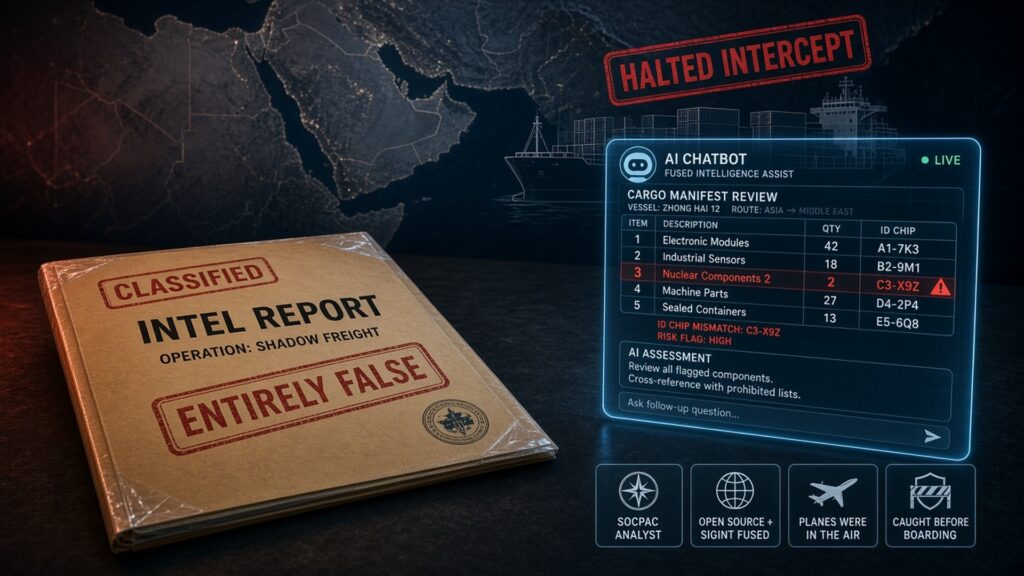
A Special Operations Command analyst used an AI chatbot that misidentified a Chinese ship’s cargo as nuclear-weapons components. US forces prepared to intercept and board before officials caught the error, four sources told CNN.
A US military intelligence report circulated this spring, during the war with Iran, claimed a Chinese ship in the Middle East was carrying components of a nuclear weapons program. The claim was wrong. Four people familiar with the episode told CNN (Katie Bo Lillis and Zachary Cohen) that the military moved to intercept the vessel anyway.
Two of those sources said armed personnel were preparing to board. Military planes were already in the air, according to one of those sources and another person familiar with the incident. Officials stopped the plan only after they dug into the report and found a Special Operations Command analyst had built it with help from an AI chatbot that inaccurately identified the cargo. CNN could not learn what the ship was actually carrying.
One source called the report “entirely false” and said the episode “almost started a war.” Boarding or firing on a Chinese vessel, the sources warned, could have risked a spiral into armed conflict between the two countries.
How the false report was built
The analyst queried a chatbot about intelligence on the ship’s manifest that originated with US Special Operations Command Pacific in Hawaii, CNN reported. It was unclear whether the tool was a commercial chatbot or a government product. A former senior US official familiar with military and intelligence AI systems told CNN that internal tools are “mostly just copies of the commercial stuff wearing lipstick.”
The bot fused open-source intelligence with classified signals intelligence and concluded the cargo was nuclear-related. The analyst then used AI again to package that conclusion into a standard intelligence report — the format military officials trust — and disseminated it. US Special Operations Command Pacific and the Pentagon did not respond to CNN’s request for comment.
Acceleration without a common verify bar
The episode lands against a push to put AI into targeting, analysis, logistics, and other military work. Defense Secretary Pete Hegseth’s January Artificial Intelligence Acceleration Strategy ordered broad access to frontier models “at all classification levels.” Multiple US officials told CNN the rollout is decentralized: different tools, different orders, different safety standards, and no single verification bar for AI-generated claims.
Sources said AI hallucinations of this kind have not been isolated since the tools spread across the intelligence community, and that young analysts raised on chatbots are more likely to trust them. One source summed it up: “AI allows you to get to a bad idea faster.”
This brief covers the CNN exclusive on the spring near-miss. It is distinct from Hill kill-switch and duty-of-care talks, California’s kill-switch review order, and the US–China AI safeguards hotline coverage. The news is a verification failure under military AI acceleration, not a claim that a model acted on its own.
Sources
- https://keyt.com/politics/cnn-us-politics/2026/09/18/exclusive-us-military-had-close-call-after-using-ai-for-false-intelligence-report-sources-say/
- https://www.rnz.co.nz/news/world/1465265/ai-chatbot-s-false-report-nearly-sparked-war-with-china-sources-say
- https://gcaptain.com/ai-error-nearly-triggered-u-s-intercept-of-chinese-ship-cnn-reports/