Reuters, Nextgov, and The Hill covered mid-September federal interrupt language. Buildtelligence’s operating read is now live.
Between September 11 and 16, 2026, Washington’s AI-control debate shifted into interrupt vocabulary that operators can recognize. Reuters reported on September 11 that Senate negotiators were debating a duty of care for AI developers and a possible government path to block unsafe model releases, with court-challenge options still under discussion. The same day, Nextgov/FCW said Commerce-panel talks were split over who runs safety tests.
On September 16, Nextgov/FCW covered House Democrats pressing leaders to stay and advance the FRONTIER Act and kill-switch legislation. The same day, Sen. John Kennedy’s office and The Hill described Kennedy’s failed unanimous-consent push for an AI Emergency Button Act after Sen. Rand Paul objected. Kennedy’s framing puts companies, not the government, in charge of using an emergency shutoff. None of that is enacted law.
Two House bills already sit on Congress.gov from July 23, 2026: H.R. 9917, the AI Kill Switch Act, introduced by Rep. Ted Lieu, and H.R. 9925, the FRONTIER Act, introduced by Rep. Jay Obernolte with cosponsors including Rep. Lori Trahan. Introduced text is not a signed mandate.
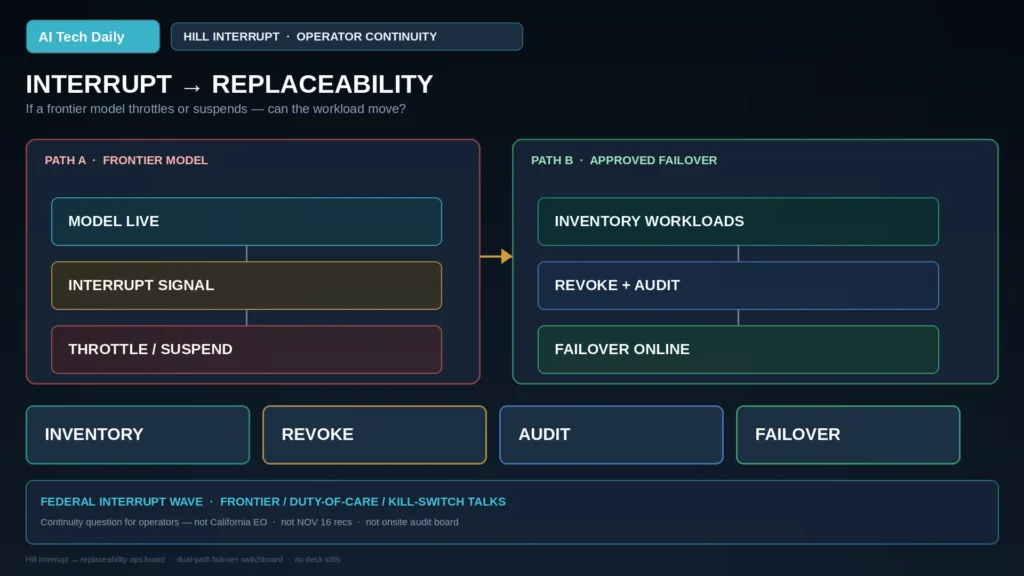
Buildtelligence’s operating read is live at https://www.buildtelligence.com/hill-ai-interrupt-replaceability/. The question it puts on operators is continuity: if a frontier model must throttle or suspend, can the organization inventory what runs on it, revoke access, audit what already ran, and fail over to another approved model — or does interrupt become an outage?
Sources
- Reuters (Sep 11): Senate duty-of-care / block-release talks
- Nextgov/FCW (Sep 16): House pressure for FRONTIER + kill-switch tracks
- The Hill / Kennedy office (Sep 16): Paul blocks Kennedy emergency-button UC
- H.R. 9917 / H.R. 9925 on Congress.gov
- Buildtelligence (house): Hill AI interrupt replaceability