
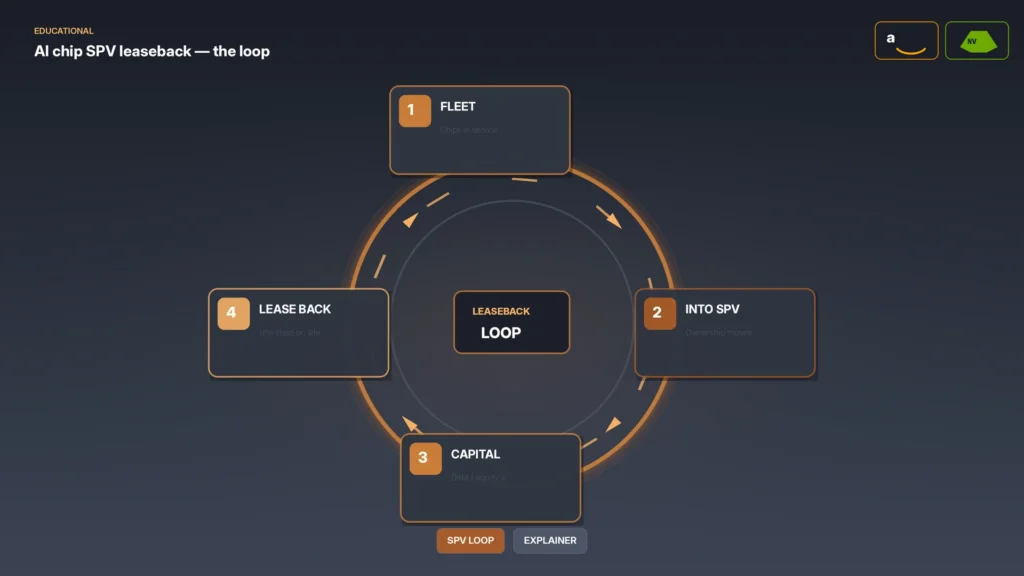
AI chip fleets are expensive enough that hyperscalers are testing ways to keep the GPUs running without carrying full ownership on the corporate balance sheet. One structure in that toolkit is an SPV leaseback: move chips into a special-purpose vehicle, raise outside capital against them, then lease the same hardware back into the data center.
Amazon's reported talks make the pattern concrete. On October 2, 2026, the Financial Times said Amazon was exploring a deal to move about $8 billion of Nvidia Grace Blackwell chips into an SPV, raise investor capital against them, and lease the GPUs back, according to Reuters wire reprints. Our news brief on those talks is here: https://www.aitechdaily.com/amazon-nvidia-8b-grace-blackwell-spv-leaseback/ This piece explains how an AI chip SPV leaseback is supposed to work, why companies chase the structure, and how it differs from nearby chip-lease headlines that sound similar but are not the same deal.
What an SPV is in this context
A special-purpose vehicle is a legal entity set up for a narrow job. In chip finance, that job is usually to hold a defined pool of GPUs (or related infrastructure), borrow or raise equity against that pool, and collect lease payments from the operator that still needs the compute.
The SPV is not the hyperscaler's main operating company. It is a separate box on paper. Investors in the vehicle look primarily to the chips, the lease cash flows, and the lessee's credit story, rather than to every other corporate asset and liability. That separation is what lets the structure be marketed as more "asset-light": expensive semiconductors leave the operator's books, while the racks stay powered. Accounting and disclosure rules still matter, and Amazon's reported talks remain exploratory investor conversations, not a closed, audited transaction.
The leaseback loop
The loop readers should keep straight has four steps.
First, the hyperscaler already has chips in service or on order. In Amazon's reported package, the chips were bought or leased by Amazon and are installed in more than a dozen U.S. data centers across five states, including Nevada and Virginia, the FT said via Reuters reprints on Channel NewsAsia and CNBC TV18.
Second, those chips are contributed or sold into the SPV. Ownership on paper moves into the vehicle. Bloomberg Law, summarizing the same FT account, described the move as shifting about $8 billion of top-end Nvidia chips off Amazon's books into an SPV funded by outside investors.
Third, the SPV raises capital. The FT account says the vehicle would tap outside investors through debt issuance, and that Amazon plans to offer an equity stake of up to 10% in the vehicle. Debt looks to lease cash flows; equity, if sold, shares residual risk in the vehicle.
Fourth, the hyperscaler leases the hardware back. Physically, little may change: the same Grace Blackwell units keep training or serving models in the same halls. Contractually, the operator is now a lessee paying the SPV for use. Compute stays in the fleet; legal ownership and much of the financing sit in the vehicle.
That is the leaseback: use without (or with reduced) on-book ownership of the underlying chip assets.
Why operators want it
Frontier AI compute is a capital-intensity problem. Buying or committing to thousands of top-end GPUs puts large numbers on the balance sheet and can pressure leverage metrics, even when the business case for the compute is strong. An SPV leaseback is one way to answer: keep the capacity, shift who funds and owns the metal.
In Amazon's reported framing, the talks are about a more asset-light approach: unload expensive semiconductors while keeping use of the hardware. The FT via Reuters account remains exploratory (talks to gauge interest, not a signed close), and Amazon and Nvidia did not immediately respond to Reuters for comment. Treat dollar figures and the up-to-10% equity detail as reported deal-talk, not a completed financing.
What this is not
Chip-lease headlines travel in packs. Three structures that readers mix up:
Hyperscaler SPV leaseback (this piece / Amazon reports). The operator's own fleet moves into a financing vehicle; the operator leases the chips back. Counterparty focus: outside debt/equity investors in the SPV, plus the operator as lessee.
Vendor-finance chip lease facility (Broadcom-Anthropic). A chip or systems vendor helps the AI lab finance leases of the vendor's own silicon. Our brief on Anthropic's IPO prospectus language about Broadcom lending up to $42 billion tied to chip leases is here: https://www.aitechdaily.com/broadcom-anthropic-42b-chip-lease-facility/ That is supplier credit and lease support for a customer, not Amazon spinning its Grace Blackwell fleet into an investor SPV.
Cloud chip lease across borders (Tencent-Oracle SE Asia). A cloud provider hosts advanced AI chips in regional data centers; another company leases that capacity. Our brief on the FT report that Tencent signed a roughly $7 billion Oracle lease for about 100,000 AI chips in Southeast Asia is here: https://www.aitechdaily.com/tencent-oracle-chip-lease-se-asia/ That is capacity rented from a cloud landlord, not an SPV owning Amazon's installed U.S. Grace Blackwell pool.
Same word ("lease"), different economics. Conflating them turns three financing stories into one mushy "everyone is leasing GPUs" takeaway.
How to read the Amazon reports
Start with the parent brief and the FT via Reuters syndication (Channel NewsAsia and CNBC TV18 reprints are readable mirrors when reuters.com is gated). Bloomberg Law's FT summary is useful for the off-books / leaseback phrasing. Do not upgrade exploratory talks into a closed $8 billion financing, invent executive quotes, or assume every adjacent lease story is the same SPV loop.
The durable point is simple: an AI chip SPV leaseback tries to keep GPUs in the data center while moving ownership and much of the capital stack into a purpose-built vehicle. Amazon's reported Grace Blackwell talks are one live test of whether investors will fund that loop at hyperscaler scale.
Sources
- https://www.aitechdaily.com/amazon-nvidia-8b-grace-blackwell-spv-leaseback/
- https://www.reuters.com/business/retail-consumer/amazon-seeks-offload-8-billion-nvidia-chips-investors-ft-reports-2026-10-02/
- https://www.channelnewsasia.com/business/amazon-seeks-offload-8-billion-nvidia-chips-investors-ft-reports-6426021
- https://www.cnbctv18.com/business/amazon-explores-shifting-8-billion-nvidia-chips-to-investors-and-leasing-them-back-20003546.htm
- https://news.bloomberglaw.com/tech-and-telecom-law/amazon-to-move-8-billion-of-chips-off-its-books-ft-says-1
- https://www.aitechdaily.com/broadcom-anthropic-42b-chip-lease-facility/
- https://www.aitechdaily.com/tencent-oracle-chip-lease-se-asia/