
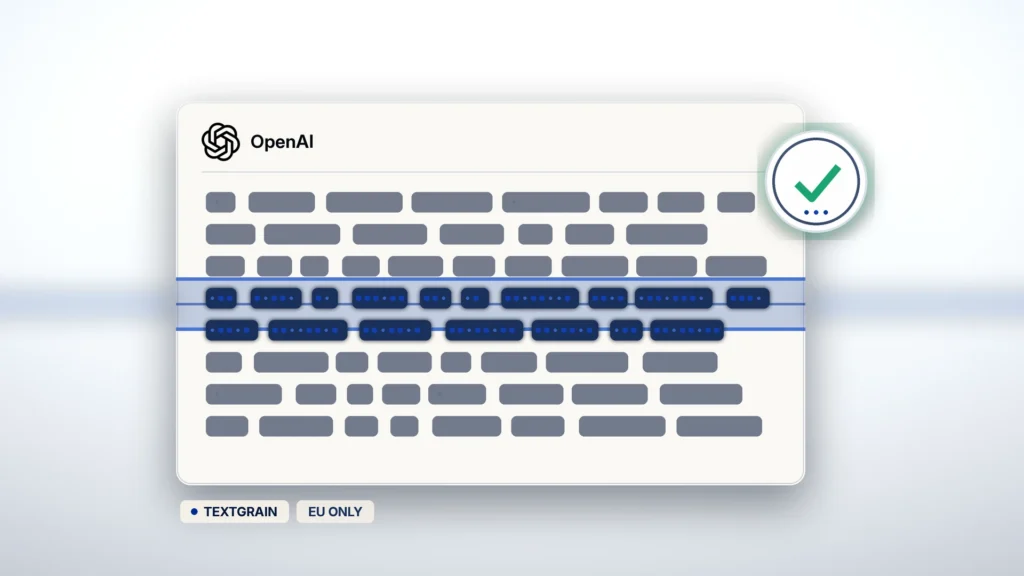
OpenAI will add invisible text watermarks to eligible ChatGPT and Codex outputs in the European Union in the coming weeks, the company said Monday in a post on EU text provenance, as it responds to EU AI Act rules that require generated text to be identifiable in a machine-readable way. Bloomberg Law also reported the EU rollout.
The watermarking system, called textGrain, adds an invisible statistical signal to the model’s word choices. A companion detector looks for that signal to assess whether a passage contains an OpenAI text watermark. OpenAI said the EU rollout will cover eligible ChatGPT and Codex text across all plans in the EU only and will not make text watermarking a global default at launch.
Starting Monday, API customers around the world can opt in to watermarked text outputs for select models. Watermarking stays off by default in the API. OpenAI is also opening applications for access to its text watermark detector, initially limited to approved researchers and expert organizations that can help evaluate the technology. Access will be granted case by case, the company said, and the tool will report whether it detects an OpenAI watermark without identifying the user.
OpenAI stressed the limits. Shorter or more constrained text is harder to detect. Editing can weaken the signal: in one evaluation of 400-token passages, replacing 10% of words with synonyms cut detection from about 92% to 66%, and replacing 25% cut it to 17%, the company said. Detectors can produce false positives and false negatives. A watermark does not measure how much a human contributed, establish ownership or responsibility, identify the user, or verify accuracy, and the absence of a detected watermark does not prove human authorship.
Across the benchmarks OpenAI uses for Astra, its latest frontier model, the company said it does not see meaningful performance differences with and without watermarking. Image and audio verification tools are already public, and OpenAI said it plans to make the textGrain technology available in open source later so others can build on it.