
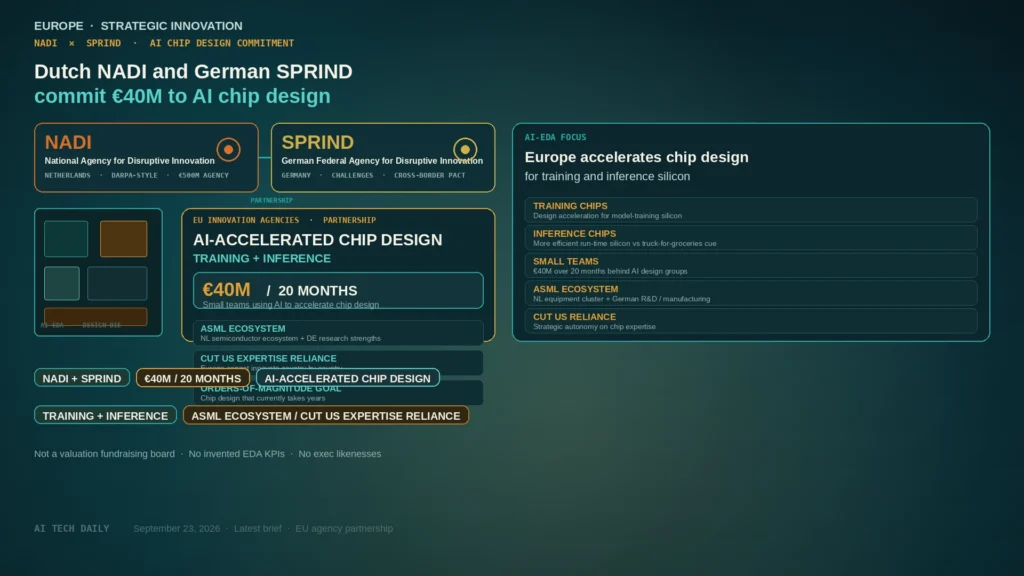
A Dutch government agency set up to foster strategic innovation will work with its German counterpart on breakthroughs in AI computer chip design, Prime Minister Rob Jetten said Wednesday, September 23, 2026, as Europe seeks to curb reliance on US expertise, Reuters reported from Amsterdam and Berlin.
The National Agency for Disruptive Innovation, or NADI, launched this month with €500 million ($570 million) of Dutch government funding as a DARPA-style agency. Jetten has backed NADI as a flagship of a competitiveness taskforce he set up after taking office in February. Cross-border cooperation makes sense, he said, because Europe “cannot afford to innovate country by country” if it wants to compete.
In the project, NADI and Germany’s SPRIND will commit €40 million over 20 months to groups of small teams using AI to accelerate the design of chips for training and inference, or running, AI models. NADI co-founder Jelle Prins said chips were a natural focus given the semiconductor ecosystem around Dutch equipment maker ASML and German research and manufacturing strengths. Prins said NVIDIA chips are powerful but inefficient for inference tasks, comparing them to “doing your shopping with a truck” rather than a grocery cart.
SPRIND’s head of challenges, Jano Costard, told Reuters the goal is “several orders of magnitude acceleration” in a chip design process that currently takes years. France established its defence innovation agency AID in 2018, Germany set up SPRIND in 2019, and Britain launched ARIA in 2023, Reuters noted, placing the NADI-SPRIND pact in a wider European push for strategic tech autonomy.
This brief covers the Wednesday NADI-SPRIND AI chip design commitment. It is distinct from AI Tech Daily’s coverage of valuation-led training-data fundraising and from earlier semiconductor equipment and foundry wires.