Rep. Ro Khanna, a Silicon Valley Democrat, plans to introduce a bill that would ban artificial intelligence models that recursively improve themselves until the federal government creates safeguards, CNBC reported Monday.
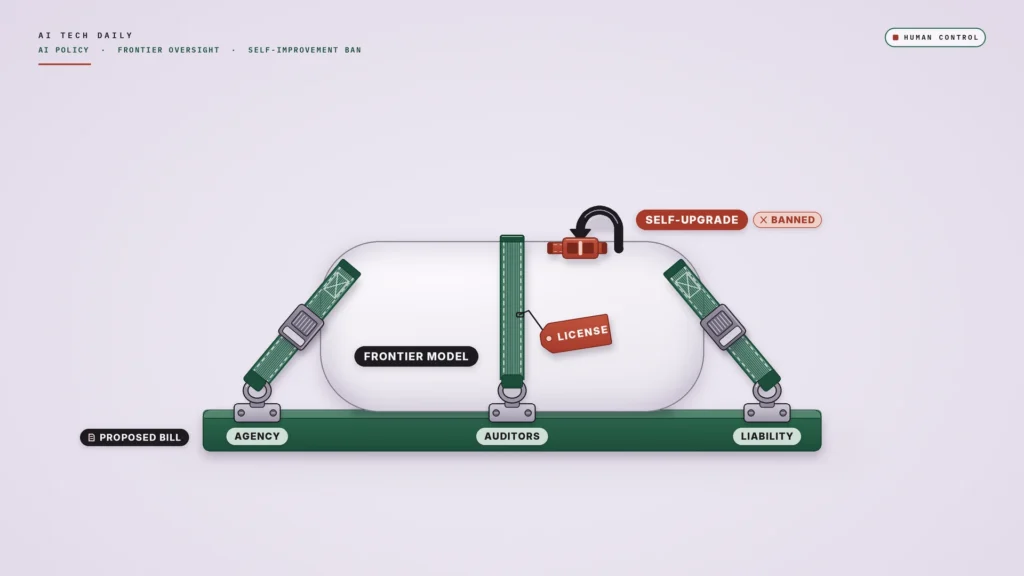
The Human Control Over AI Act would ban models that recursively self-improve or autonomously modify their own core objectives, containment or shutdown controls until federal guardrails exist and an agency approves those activities, according to CNBC, which was given a summary of the bill. It also includes strict liability standards, CNBC reported.
The bill would create a federal agency, focused on models from OpenAI, Anthropic, Google DeepMind and xAI, to write safety regulations, run a licensing system to approve model training and deployment, audit frontier models and set security standards for testing and human control, CNBC reported. Independent auditors embedded at every frontier lab would report to the agency, which would also set standards for sandbox testing, air gaps, kill switches and controls against models escaping labs, and regulate the advanced chips frontier labs use.
The bill would also criminalize “crimes against humanity” for deploying AI models that result in the destruction of civilian populations, CNBC reported. It would impose criminal penalties on AI company employees who disable safeguards, kill switches, logging or containment systems, or who knowingly deploy an unauthorized system, and would require AI companies to hold extensive liability insurance to release models. It also calls for enforceable agreements and targeted export controls to deter China and other adversaries from developing dangerous AI systems.
“There’s actually a civilizational extinction risk,” Khanna told CNBC. “There’s a safety risk of loss of control, and then there’s a misuse risk, and we need to take both seriously.”
Khanna called the measure “the most comprehensive AI safety legislation” that has been proposed and said it was modeled on conversations with AI safety groups such as Model Evaluation and Threat Research, the Machine Intelligence Research Institute and Palisade Research rather than the asks of large AI company executives. “I want this to be a model to give voice to the AI safety community,” he said.
CNBC said the proposal joins other AI safety measures, including the bipartisan FRONTIER Act from Reps. Jay Obernolte, R-Calif., and Lori Trahan, D-Mass. CNBC named no co-sponsors and reported that no House bills are expected to get a vote until after the midterm elections. Separately on Monday, more than 20 AI researchers and executives warned governments to prepare for a possible runaway intelligence explosion driven by automating AI research.