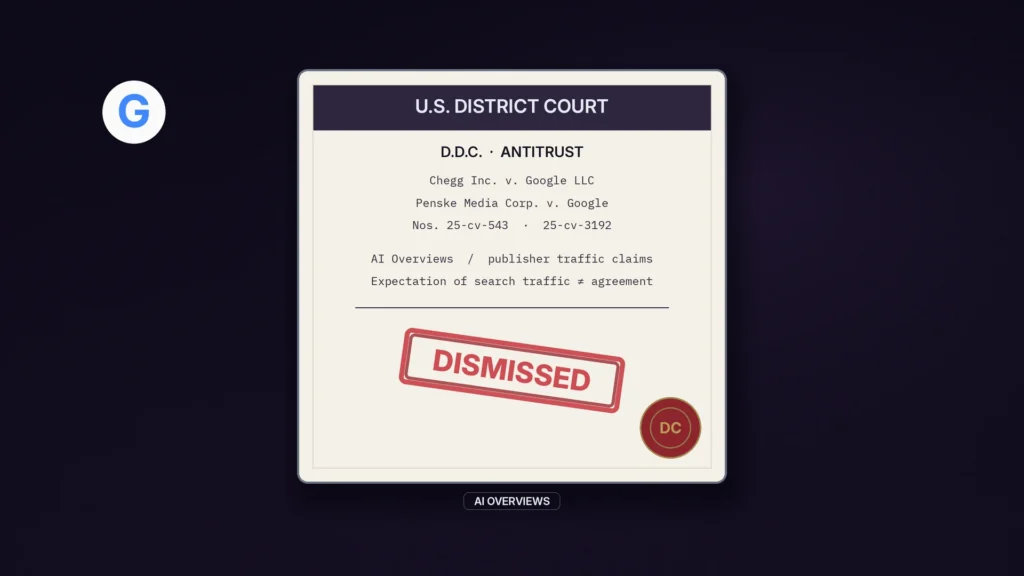
U.S. District Judge Amit Mehta in Washington dismissed antitrust lawsuits by education-tech firm Chegg and Rolling Stone parent Penske Media Corp. alleging Alphabet’s Google unlawfully forced publishers to supply content for AI Overviews that pull readers away from their sites, Reuters reported on October 1, 2026. The Verge corroborated the ruling.
In suits filed last year, Chegg and Penske — which also publishes Billboard and Variety — argued Google broke antitrust law by coercing publishers to allow AI summaries of their content as a condition of remaining indexed in search results, and that the practice cut traffic and revenue. They said a competitive market would have required Google to pay for republishing their work or using it to train AI systems. Google has denied wrongdoing and argued it has no obligation to index publishers on their preferred terms.
Mehta wrote that the claims “fail to get out of the starting gate.” “Plaintiffs have pleaded only that they have an ‘expectation’ that Google will send them search traffic if they make their content available for free,” he said. “But an expectation is not an agreement. It is simply how a general search engine works.”
The judge said he is not “unsympathetic” to publishers whose content Google takes and repurposes without compensation, but held that antitrust law does not substitute for legislation on how innovation may cause economic harm. He rejected similar publisher claims against Google in March. Chegg, Penske, and Google did not immediately respond to requests for comment on the fresh dismissals, Reuters said.
The cases are Chegg Inc. v. Google LLC, D.D.C. No. 25-cv-543, and Penske Media Corp. v. Google, No. 25-cv-3192.