
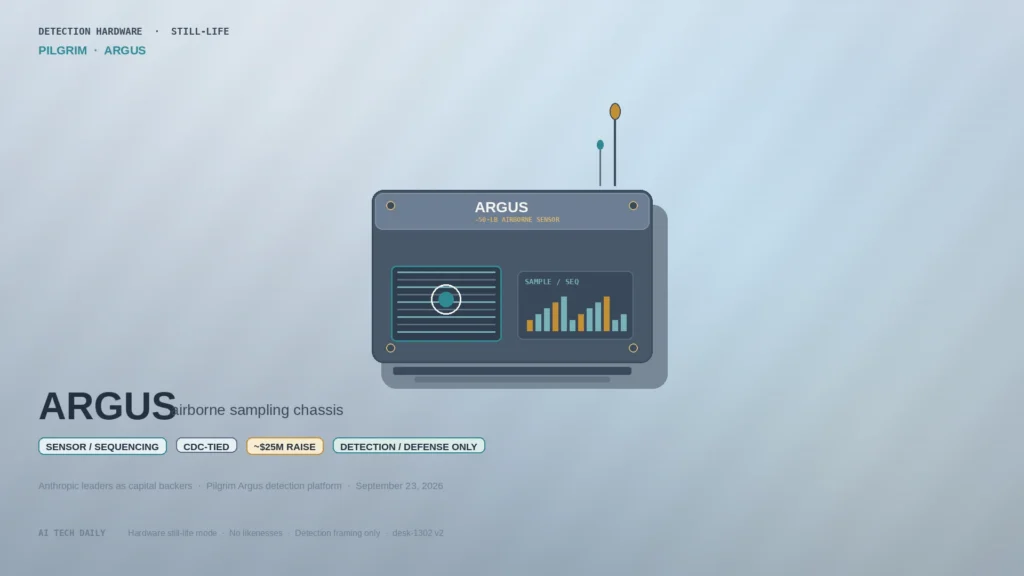
Two Anthropic leaders have invested in Pilgrim, a startup developing technology to detect airborne biological threats, the Wall Street Journal reported in an exclusive on Wednesday, September 23, 2026.
Pilgrim raised about $25 million at a valuation of roughly $150 million, according to the Journal. The company has developed Argus, described as a sensor and genomic-sequencing system intended to spot dangerous biological agents in the air. Coverage framed Argus as an about 50-pound airborne detection platform designed to flag threats such as Ebola and anthrax as examples of agents it is built to detect, not as a guide to how those agents work.
Pilgrim works with the U.S. Centers for Disease Control and Prevention on related biosecurity detection efforts, the Journal reported. The investment story sits the Anthropic-linked capital in a defense and public-health detection lane rather than in a new frontier model release.
The company positions Argus as early-warning hardware for biological threats in the field. Public company materials describe Argus as an autonomous near-real-time detection platform for biological threats, from naturally occurring pathogens to engineered agents, in a detection and defense role. This brief stays in that detection frame. It does not describe pathogen production, enhancement, laboratory methods, or any offensive use.
The Pilgrim raise lands as AI labs and investors put more attention on biosecurity as a national-security and public-health risk domain. Anthropic has separately highlighted biological-risk safeguards around its own models; the Journal story is about executive-level capital backing an external detection startup, not about Anthropic shipping Argus itself. Funding round figures and the CDC collaboration detail are attributed to the Journal exclusive and were echoed in same-day market summaries citing that report.
This brief covers the WSJ exclusive on Anthropic leaders investing in Pilgrim and the Argus airborne detection system. It is distinct from Anthropic’s own life-sciences lab reporting and from medical-AI product wires.