
Anthropic introduced a new life sciences research group and Bay Area wet lab focused on fundamental biology with Claude, from genome mining and hypothesis generation through human lab tests, the company said on Wednesday, September 23, 2026.
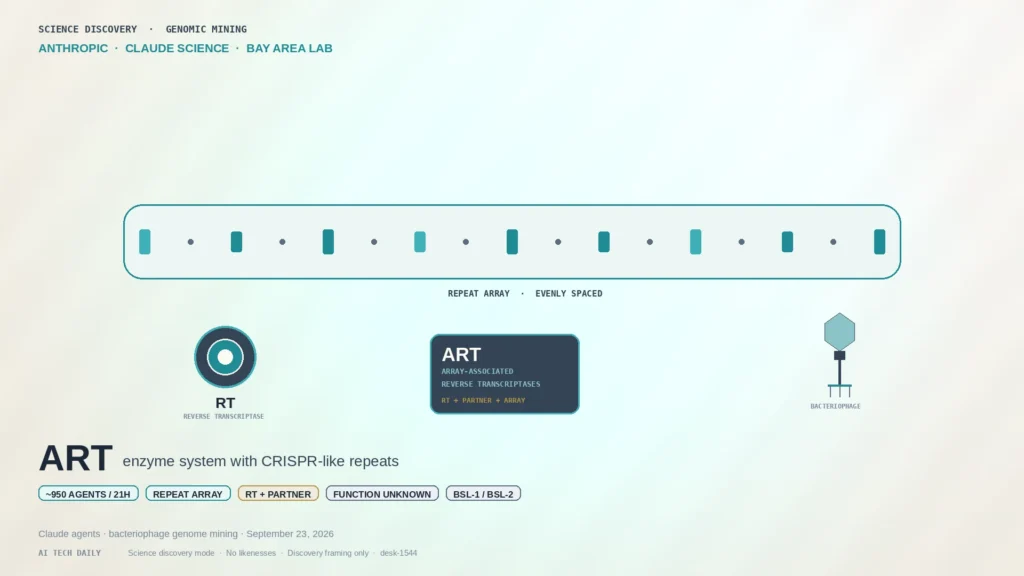
In an early result, Claude autonomously discovered a novel enzyme system Anthropic calls array-associated reverse transcriptases, or ART, with CRISPR-like DNA repeat arrays. The company said a roughly 21-hour campaign of about 950 Claude agents used about 210 million tokens to search a massive DNA and reverse-transcriptase database, with human involvement limited to the initial prompt and the lab work.
Claude spotted a tandem repeat array next to an odd reverse-transcriptase gene in bacteriophages. The underlying jumbo-phage reverse transcriptase had been seen before; Anthropic said Claude was first to notice the associated non-coding repeat array and an accessory protein of unknown function. ART pairs the reverse transcriptase with a partner gene and an evenly spaced DNA repeat array. First experiments show the array is expressed as distinct short RNAs; the primary function is still unknown, and further experiments are underway. Anthropic said it released a pre-print on the finding.
Feng Zhang of MIT and the Broad Institute, quoted in Anthropic’s post, called the work an exciting example of how AI agents can contribute to biological discovery and said the RNA-repeat arrays associated with reverse transcriptases merit further investigation.
The Verge’s Robert Hart reported the same day that practical applications remain unclear and that sharing the finding this early is premature by usual science standards, while Anthropic said it is sharing early to demonstrate Claude’s capabilities and give the research community insight. The Verge also framed the push in the context of Anthropic preparing to go public and recruiting scientists. Anthropic said the Bay Area lab operates at BSL-1 and BSL-2 only, that humans perform the lab work, and that it does not handle pathogens that infect humans.
This brief covers Anthropic’s own science and wet-lab discovery track for ART. It is distinct from same-day coverage of Anthropic leaders backing Pilgrim’s Argus bio-threat detection investment.