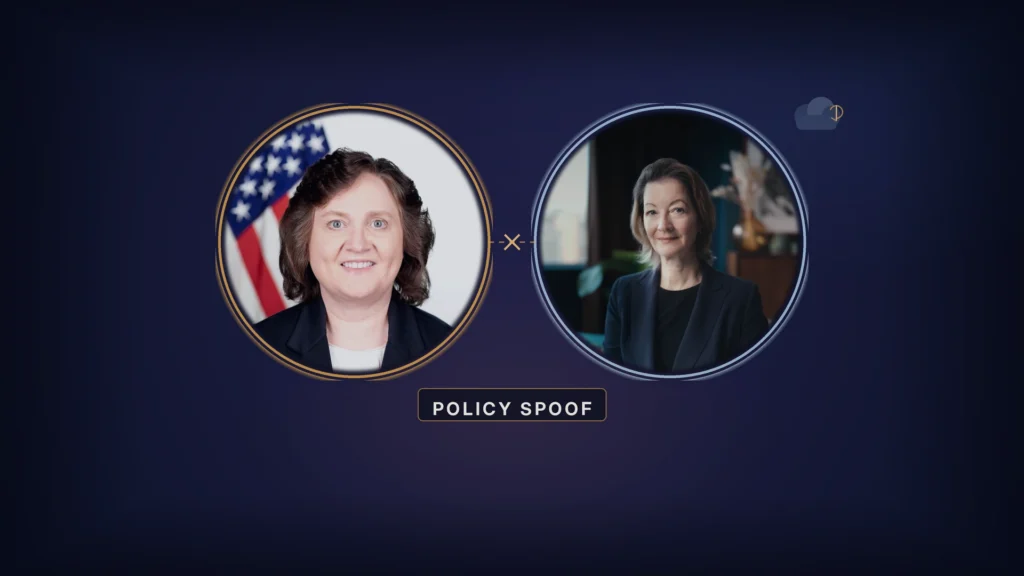
China-aligned threat actor TA419 ran credential phishing in July 2026 against artificial intelligence policy experts at U.S. think tanks, universities, and law firms by impersonating former White House AI officials and other prominent voices, Proofpoint said in an October 1 report. Reuters and Nextgov corroborated the findings.
Beginning July 8, the group impersonated Lynne Parker, former principal deputy director of the White House Office of Science and Technology Policy and founding director of the National AI Initiative Office, then Heidi Crebo-Rediker, a former State Department chief economist and Senate Foreign Relations Committee international-finance lead. Openers invited targets to join a fictitious “AI Policy Advisory Committee” or contribute to a purported Senate Foreign Relations Committee report on AI export controls and supply chains. After a reply, TA419 sent a shortened URL that redirected through actor domains including driftshare[.]co into globalfileshareplatform[.]com, landing on a fake OneDrive page. Proofpoint said the chain used an Adversary-in-the-Middle kit built on Frameless Browser-in-the-Browser tooling against Microsoft 365, designed to steal session cookies even when multi-factor authentication succeeds.
In February 2026, the same actor impersonated a senior Anthropic employee — unnamed in the report — with the subject line “Request for Feedback on Military Integration of Claude,” targeting a think-tank AI policy analyst. Proofpoint also said TA419 registered domains spoofing the Heritage Foundation, Japanese Defense Minister Shinjiro Koizumi’s site, and the Japan–Taiwan Exchange Association. The company did not report how many people were targeted, whether any accounts were compromised, or whether any data was obtained.
Parker told Nextgov she learned of the impersonation on July 9 when two recipients asked whether she had sent the emails; she confirmed the messages were fraudulent and alerted colleagues. “It is personally troubling to see the trust and relationships I’ve built over my career exploited to deceive others,” she said. Crebo-Rediker and Anthropic did not comment; China’s embassy in Washington did not respond, consistent with Beijing’s routine denials of state-backed hacking allegations.
The campaigns sit beside intensifying U.S.–China AI competition over export controls and model distillation. Related coverage includes OpenAI’s report that it disrupted a July distillation campaign it attributed in part to a Moonshot-linked cluster.