Google on Wednesday introduced Gemini 3.8 Flash TTS and Gemini 3.8 Flash-Lite TTS, reframing text-to-speech as a generative voice studio rather than a fixed preset picker, according to the company blog and The Next Web.
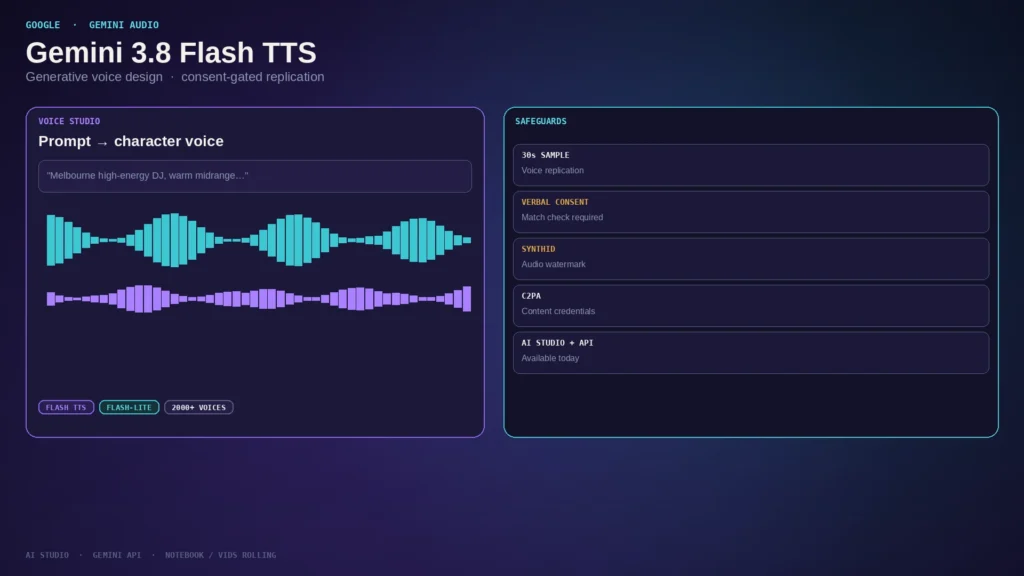
Flash TTS is positioned for creative direction — games, audiobooks, podcasts, and interactive media — with natural-language prompts that design role, accent, and character across more than 100 languages and dialects. Flash-Lite TTS targets high-volume dubbing, audio content, and expressive voice agents with finer cost and scale tradeoffs. Both models support line-by-line stage directions, two-speaker scenes from a single script, long-form generation lasting hours, and scripted vocal bursts or backchannel cues.
The creative surface scales beyond Google’s earlier 30 original voices. Flash TTS can generate bespoke voices from prompts, draw from a library of more than 2,000 production-ready voices (including regional varieties such as Mexican Spanish, Quebec French, and Scots English), and recreate a consistent vocal profile from a 30-second sample when the user also supplies a matching verbal consent recording from the voice owner. Generated clips carry SynthID watermarks; replicated voices also get C2PA credentials, Google said.
Both models are available starting today in Google AI Studio and the Gemini API. Flash TTS is also rolling into Gemini Notebook; Flash-Lite TTS into Google Vids; enterprise API access is listed as coming soon. Google named partners including Figma, HeyGen, Linguana, Wondercraft, 99.co, and Ollang as integrating the new models for dubbing, localization, and conversational agents. Voice replication through AI Studio is not available in Illinois, Texas, the EEA, the UK, Switzerland, and India.
Google said Flash TTS ranked first on Hume AI’s Voice Design Benchmark (71.4) and that Flash and Flash-Lite led Hume’s Overall Quality Index in its testing, with strong Voice Arena preference results in languages including Japanese, Hindi, and Mexican Spanish. Those scores are company-cited benchmarks, not independent AITD audits.
The Wednesday release puts generative voice design and consent-gated replication into the same Gemini Audio stack as Live Translate, Transcribe, and Live models, with watermarking treated as a default surface rather than an add-on.
This brief covers Gemini 3.8 Flash and Flash-Lite TTS product availability, voice design, replication safeguards, and partner rollout. It is distinct from AI Tech Daily’s coverage of YouTube’s Gemini-powered Studio and Shorts creator tools.