
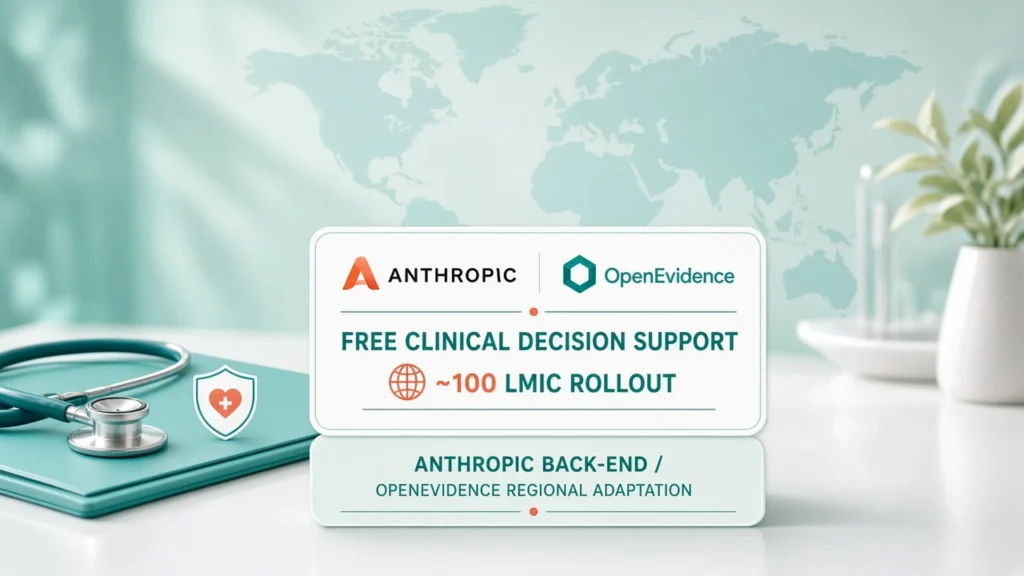
Reuters exclusive: Anthropic and OpenEvidence are rolling out free AI clinical decision support for physicians in about 100 low- and middle-income countries, with Anthropic providing the back end and OpenEvidence adapting the system by region.
Anthropic and medical knowledge platform OpenEvidence are collaborating to bring AI-powered clinical decision support to physicians in regions without access to the technology, the companies said Tuesday, Reuters reported in an exclusive.
OpenEvidence answers doctors’ questions using peer-reviewed research and treatment guidelines and is already free to clinicians in the United States and Europe. The new initiative is a specialized version free to healthcare providers in dozens of low- and middle-income countries where limited access to medical literature, specialists, and continuing education can impair care. The rollout covers about 100 countries, including Uganda, Angola, Sudan, Haiti, and Mongolia, according to a list OpenEvidence provided.
Anthropic’s technology will provide back-end support, while OpenEvidence will tailor the system by region, taking healthcare infrastructure into account. Financial terms were not disclosed. “Access to medical knowledge shouldn’t depend on geography,” OpenEvidence founder Daniel Nadler told Reuters. He said the tools are “context adaptive” for settings where disease patterns, diagnostics, and treatments differ from wealthier countries, and that even where facilities lack round-the-clock electricity, most physicians have smartphones.
In August alone, U.S. clinicians consulted OpenEvidence 42 million times, Nadler said. Supporters argue generative AI can help navigate vast medical information amid physician shortages; critics caution that systems trained mainly on high-income-country data may not reflect local practice. Dr. Ahmed Bendary, a cardiologist at Benha University in Egypt, said expanding access outside the United States and Europe would be “a tremendous leap forward” where institutional journal subscriptions are limited.
This brief covers the attributed partnership announcement. It does not evaluate clinical outcomes or treat OpenEvidence as a substitute for local standards of care.