
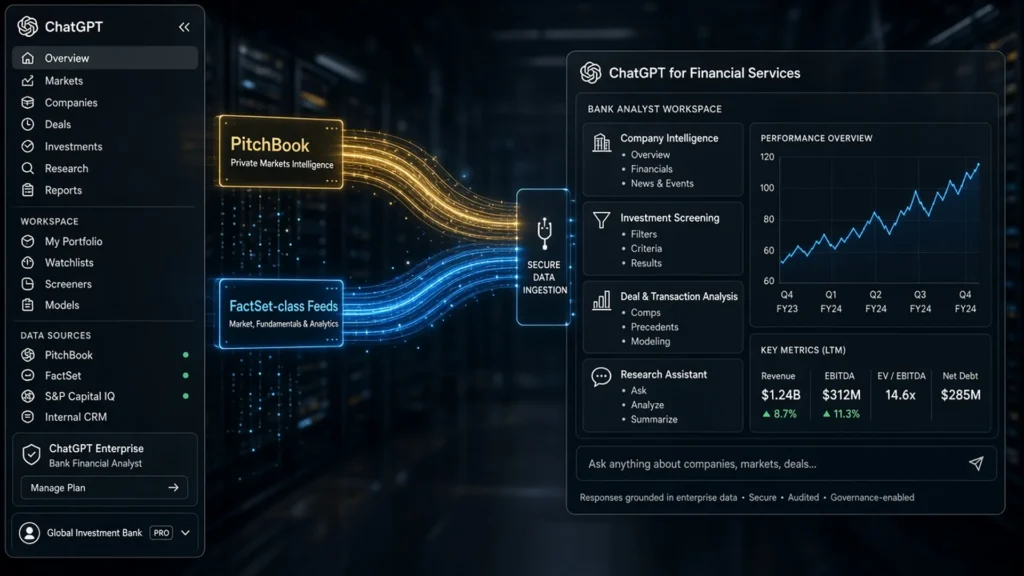
OpenAI’s bank-focused ChatGPT build is not a sticker on the consumer app. Here is why a vertical product, design partners like Morgan Stanley and Evercore, and market-data pipes matter.
OpenAI on September 10 launched ChatGPT for Financial Services, a tailored enterprise product for investment bankers and equity researchers. Reuters and CNBC covered the release. Our launch brief is here: https://www.aitechdaily.com/openai-chatgpt-financial-services/. This piece explains what the product is, how it differs from wrapping generic ChatGPT, and why OpenAI’s design partners and data integrations sit at the center of the pitch.
What it is
ChatGPT for Financial Services is a finance-specific ChatGPT Work experience that sits on ChatGPT Enterprise controls and runs on GPT-6 Astra, OpenAI’s newest model. Reuters reported that the product combines that model with built-in access to financial datasets, including PitchBook, Daloopa, LSEG News, Crunchbase, and Quartr. OpenAI said the data is indexed on its infrastructure to improve retrieval and citation.
In practice, OpenAI and the wire coverage describe a workflow aimed at research and client materials: look up companies across those sources, analyze earnings and fundamentals, build financial models, and generate pitchbooks or other decks using a firm’s own templates. CNBC quoted Nick Turley, OpenAI’s vice president of product for ChatGPT, saying the company is teaching ChatGPT to research like an analyst and back up its conclusions like an analyst. In a demo Turley showed the tool analyzing a potential M&A target, pulling figures from industry data sources, and producing a formatted PowerPoint from a firm template.
Access is not a consumer checkout. Reuters said the offering builds on ChatGPT Enterprise features such as role-based access, encryption, and exportable workspace logs for compliance. CNBC and OpenAI described it as available to eligible institutions through OpenAI’s sales channel, not as a self-serve add-on for every ChatGPT Plus subscriber.
Why a vertical bank build is different from generic ChatGPT
Generic ChatGPT, even with a strong model, does not know which PitchBook table or Daloopa line item your bank is licensed to use. It also does not automatically format a pitchbook in your firm’s template language. Banks already pay for market data, and compliance teams care about who saw what, what was exported, and whether a number can be traced to a source.
A vertical build tries to solve that stack in one product. First, it ships with finance-relevant data already wired in, so the model is not starting from a blank web search for every filing or private-company profile. Second, it emphasizes citations so analysts can check claims against tables and passages. Third, it inherits Enterprise governance: roles, encryption, and audit logs that regulated buyers expect. Fourth, it aims at the artifacts banks actually ship to clients, not only chat answers.
That is different from pasting a Bloomberg screenshot into a consumer chat window or bolting a thin prompt wrapper on top of the public product. The model still matters. Reuters said Astra was built to improve retrieval across financial tools, financial reasoning, and the accuracy of generated content. But the product claim is the combination: model plus licensed data pipes plus firm templates plus compliance controls.
OpenAI is not alone in this lane. Our launch brief noted that Anthropic previously shipped Claude for Financial Services. The September release is OpenAI’s answer for the same regulated buyers.
Why Morgan Stanley, Evercore, and the data pipes matter
OpenAI said Morgan Stanley and Evercore served as design partners. That label matters more than a press-quote cameo. Design partners help decide which workflows ship first. Turley’s team, CNBC reported, worked with those firms on the initial focus: investment banking and equity research. OpenAI’s own post said reliable data access and high-quality artifact creation were the biggest pain points their partners flagged. Those choices explain why the first version leans into research, models, and pitchbooks rather than, for example, retail brokerage chatbots.
Market-data pipes are the other half of the story. Built-in sources give every eligible customer a baseline of transcripts, statements, private-company profiles, and news. Firms that already buy deeper feeds can connect subscriptions through integrations Reuters listed with FactSet, S&P Global, Preqin, and Datasite. Without that plumbing, a frontier model is still guessing from training cutoffs and open web results. With it, the product can ground answers in the same vendor ecosystems banks already trust, subject to each firm’s entitlements.
LSEG News is a useful example of how industry-specific the stack is. Reuters noted that LSEG is the sole distributor of Reuters news, financial data, and real-time alerts to global financial professionals. Embedding that kind of feed is a signal that OpenAI is selling into the existing terminal-and-vendor world, not trying to replace it overnight.
Turley told CNBC OpenAI sees “a ton of demand” for the product but declined to name banks that have signed on beyond the design-partner framing. He framed the tool as an efficiency boost for analysts working long hours, comparing it to how Excel changed bank workflows, rather than as an explicit plan to cut junior hiring. OpenAI said it plans broader data coverage and expansion beyond bankers and equity researchers across wider financial services.
Who this is for, and what it is not
Who: investment banking and equity research teams at eligible institutions that already operate under ChatGPT Enterprise-style controls, at least for this first release.
How: Astra plus indexed financial datasets plus optional connected subscriptions plus firm templates, sold through OpenAI’s institutional channel.
Why: banks want faster research and client-ready materials without abandoning citation, entitlements, and audit requirements. OpenAI wants enterprise revenue in a regulated vertical where rivals are also courting the same buyers.
What it is not: a free consumer finance mode, a substitute for a bank’s compliance program, or a verified claim that junior analyst headcount will fall.
For the September 10 launch details and partner list, start with our news brief and the Reuters and CNBC accounts. The educational point is simpler than the branding: ChatGPT for Financial Services is OpenAI trying to make a bank’s data stack and templates first-class inputs, not afterthoughts pasted into a general chatbot.
Sources
- https://www.reuters.com/business/openai-launches-chatgpt-financial-services-industry-2026-09-10/
- https://www.cnbc.com/2026/09/10/openai-chatgpt-for-financial-services-targets-work-of-junior-bankers.html
- https://www.aitechdaily.com/openai-chatgpt-financial-services/
- https://openai.com/index/introducing-chatgpt-financial-services/