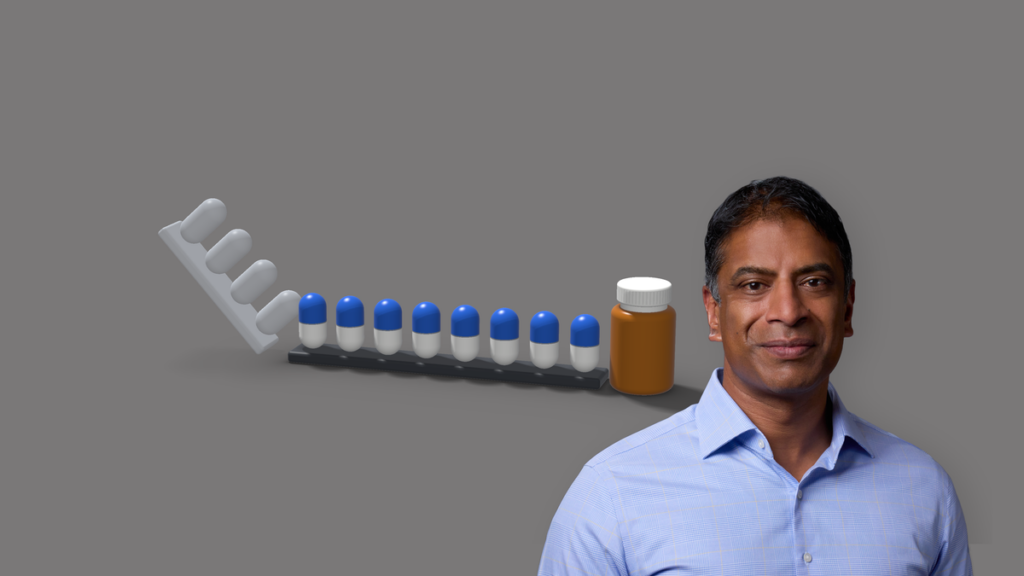
Novartis CEO Vas Narasimhan rejected the idea that AI will cure cancer within five to 10 years, saying it would take a decade to cut four years from drug development, the Financial Times reported Nov. 23. Narasimhan sits on Anthropic’s board of directors.
In the interview with the FT’s Hannah Kuchler and Tim Bradshaw, Narasimhan predicted that AI could reduce the average drug development process from 12 years to eight within a decade. He said he hoped it could also raise the share of potential medicines that succeed after entering first studies in humans from 8% to 12%.
Novartis has found AI most useful in early drug discovery, before human testing, where it could save up to two years of a phase that usually took four, on average, the FT reported.
“The real underlying issue we face is that we only understand about, we would argue, 5 per cent of what goes on in the human body,” Narasimhan said. “In coding and in language we understand a much higher proportion and so the AI model’s ability to learn and predict is much higher.”
He said the true impact of AI was probably “somewhere in the middle” of AI companies’ predictions and the more skeptical view of the pharmaceutical industry. “I don’t think we’ll get away from the fact that in this period, you still need to put these medicines into animals and then humans to test the biological functions of these compounds,” he said.
The FT contrasted his view with claims from AI leaders. In his 2024 essay Machines of Loving Grace, Anthropic CEO Dario Amodei wrote that “my basic prediction is that AI-enabled biology and medicine will allow us to compress the progress that human biologists would have achieved over the next 50-100 years into 5-10 years,” a period he described as following the development of powerful AI.
Last week, Fiona Marshall, the company’s president of biomedical research, told Reuters that the average time from project start to a drug candidate has gone from three years to about 18 months to two years. Reuters reported that drugmakers are weighing Anthropic as a rival, partner or both as it expands its own drug development work.