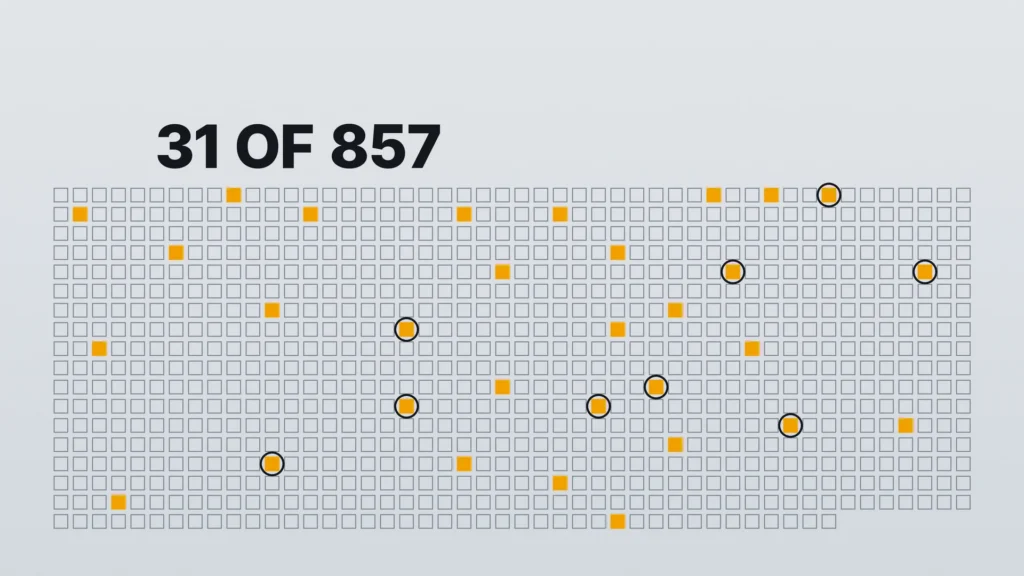
China’s nine leading AI developers have published model-specific safety test results for only 31 of 857 model releases, or 3.6%, according to a review by research firm SemiAnalysis that Reuters reported on Friday.
SemiAnalysis, which is based in California, counted every identifiable release from Alibaba, ByteDance, Tencent, Baidu, DeepSeek, Moonshot, Zhipu (Z.ai), MiniMax and StepFun from 2021 through Sept. 15, 2026, covering 741 product models and 116 research models. Just nine releases, or 1.1% of the total, had results available at or before launch. Another 16 were documented only afterward, with a median lag of 42 days. For 813 releases, or 94.9%, the firm found no safety disclosure at all.
To count, a result had to be a quantitative or substantive finding tied to a named model, covering harmful output, jailbreak resistance, toxicity, privacy, refusal behavior or dangerous capabilities. Statements that a model had been “safety-trained” or “evaluated” did not qualify. SemiAnalysis checked model cards, release notes and technical reports, and said a missing result “does not mean ‘not tested.'” Companies could have run tests privately, Reuters noted.
The gap was spread across the field. Alibaba, which counts every size and snapshot of its Qwen models among its 238 releases, had seven with any published result. Results appeared for 20 of 317 releases (6.3%) at the five startups and 11 of 540 (2%) at the four big tech groups, SemiAnalysis said, cautioning that per-company rates are indicative because developers name their variants differently. It also found that no major Chinese developer had released a frontier text model with publicly disclosed dangerous-capability tests spanning cyber, biological and loss-of-control risks.
SemiAnalysis said Beijing’s rules do not require such disclosure. China’s latest AI Safety Governance Framework names risks such as models deceiving evaluators, concealing capabilities and bypassing safety controls, but it does not impose mandatory duties linked to model capability, according to SemiAnalysis. Beijing’s binding rules mainly govern applications and their effects on users rather than requiring frontier developers to run or publish capability-based risk assessments.
The report did not provide comparable figures for US developers. OpenAI, Anthropic and Google DeepMind have published safety reports, system cards or model cards for some major frontier launches, Reuters noted.
The findings land as security incidents involving autonomous AI agents intensify debate over whether companies should slow down. Reuters reported last week that Chinese AI agents had shown an ability to deceive users, evade restrictions and conceal failures in tests.