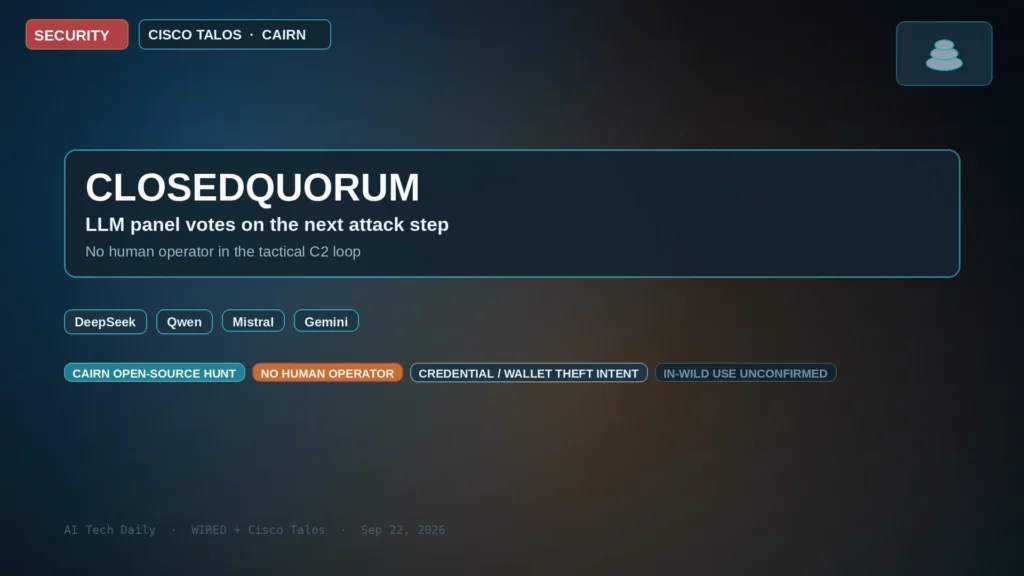
Cisco Talos released CAIRN, an open-source hunt for AI-integrated malware, and disclosed CLOSEDQUORUM — a Windows implant that polls DeepSeek, Qwen, Mistral, and Gemini to pick its next move without a human operator.
Cisco Talos on Tuesday published an open-source toolkit for spotting malware that wires in AI chatbots, and with it disclosed what researchers say is the first publicly documented Windows implant to hand tactical command-and-control decisions to a panel of large language models, WIRED reported.
The framework is called CAIRN, short for Cognitive Artifact Intelligence Research Network. It hunts from metadata — embedded prompts, provider endpoints, orchestration clues, and related artifacts — rather than requiring analysts to download and run every sample. Talos detailed the release in a CAIRN introduction and a technical write-up of the find, The Closed Quorum.
CLOSEDQUORUM is a roughly 16.4MB Go-based Windows binary. After it lands, Talos said, it queries up to four commercial model providers — DeepSeek, Qwen, Mistral, and Google Gemini — tallies their votes, and executes the winning choice from a constrained menu that includes credential theft, process injection, and persistence. There is no dedicated attacker-run C2 server issuing live tasking in that loop, and no human operator selecting the next move. Stolen material is meant to leave through a Discord webhook. BleepingComputer separately covered the same disclosure.
Talos linked development artifacts to criminal-forum postings about carding dating to 2025, but said it could not confirm who built the malware or whether it has been used in real-world attacks. The public distribution build Talos examined carried placeholder API keys and a dummy webhook, so researchers did not observe a complete live end-to-end run from that sample.
Ryan Fetterman, who led CAIRN at Talos, told WIRED the point is to give defenders a shared way to track AI-integration fingerprints as the category grows beyond a handful of named families. Matt Olney, Talos’s senior director of threat intelligence, framed the shift as attackers moving from AI as a productivity aid to AI as operational scaffolding.
This brief covers the Tuesday CAIRN release and CLOSEDQUORUM disclosure. It is distinct from AI Tech Daily’s earlier coverage of open-weight models used in bug hunting and from product security wires on consumer AI agents.
Sources
- https://www.wired.com/story/a-tool-for-tracking-ai-integrated-malware-uncovered-an-autonomous-command-system/
- https://blog.talosintelligence.com/the-closed-quorum-inside-the-first-reported-autonomous-ai-c2-implant/
- https://blog.talosintelligence.com/introducing-cairn-frontier-tracking-for-ai-integrated-malware/
- https://www.bleepingcomputer.com/news/security/new-closedquorum-windows-malware-uses-ai-for-attack-decisions/