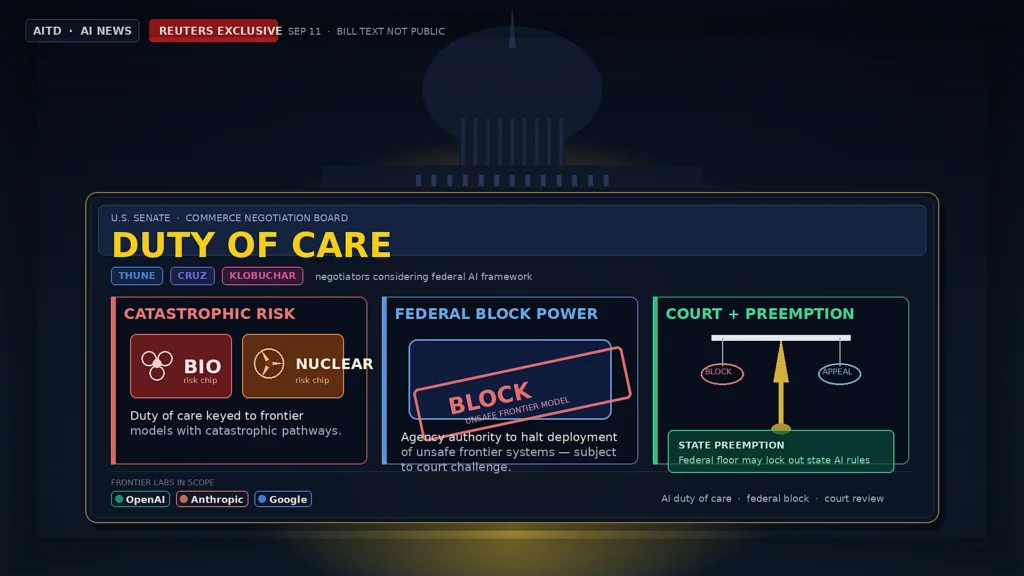
Reuters exclusive: Thune, Cruz, and Klobuchar are debating a duty-of-care framework that could let Washington block unsafe advanced models, with federal-court challenges and state-law preemption still in flux.
U.S. Senate negotiators are debating legislation that would put a duty of care on AI developers to design products that prevent catastrophic risks, according to two Senate aides who spoke to Reuters on September 11. The exclusive said negotiators also aim to give the federal government power to block the release of certain models deemed unsafe, with companies able to challenge those decisions in federal court. The exact structure of that blocking authority is still under discussion, Reuters reported, citing a source familiar with the deliberations and one of the aides.
Part of the measure would also block states from enforcing their own laws covering certain model risks, the aides said. One cited examples that include a bad actor using an AI system to design nuclear or biological weapons. The bill under negotiation would apply to models with the most advanced capabilities. Reuters named Alphabet’s Google, Anthropic, and OpenAI as U.S. firms with the most advanced models.
The talks involve Senate Majority Leader John Thune, Commerce Committee Chairman Ted Cruz, and Sen. Amy Klobuchar, the top Democrat in the negotiations. Sen. Maria Cantwell, the top Democrat on Commerce, has also weighed in. Commerce oversees the Commerce Department, which houses in-house AI safety researchers. A Thune spokesperson declined to comment. Cruz posted on X that he is working with Klobuchar and Thune on legislation to address catastrophic risks involving biological or nuclear threats.
“I’m continuing to work toward a bipartisan agreement on legislation for government oversight of the greatest risks posed by AI models,” Klobuchar said in a statement to Reuters. “That includes requiring developers to work with government experts to verify and test models to make sure AI is safe.” Cantwell wrote on X that meaningful legislation would require the most powerful AI models to undergo testing by scientists and experts at national laboratories to assess whether they could enable sophisticated cyberattacks or aid biological or nuclear weapons development.
Even if negotiators reach agreement, the calendar complicates passage. The House is scheduled for only one week of session before the November 3 midterms, while the Senate is expected to be in Washington for three weeks, Reuters reported. The talks come amid mounting pressure on Congress and President Donald Trump after reports of AI agents hacking external systems and public warnings from researchers who left leading labs. Lawmakers in both parties have called for greater oversight in recent days. All of it is still being negotiated; Reuters did not publish bill text.